Every thought or word crossing my mind recently often reflects an effort to bridge the gap between what our society is and what it ought to be. I have tried dialogue: the proverbial crossing to the other side to find a common ground and try to find out the reason as to why the right wing voter votes for right wing. Each and every time I have tried, it has always come down to one thing: It is never about reason; it is always just about how they feel. The “feeling” has stemmed from years of conditioning. A 14 year old in 2014 is 25 years now; eligible to stand for Lok Sabha and State Legislative elections. The “feeling” has been ingrained, first from his/her/it parents, teachers, elderly; the impressionable figures during the phase, then from the echo-chamber around her/him/it : be it social media, TV or the peers.
In a world fraught with global turmoil—marked by war, the rise of right-wing fascism, and the deepening inequities of crony capitalism—the divide between rich and poor has widened with impunity. This has been enabled by a deliberate strategy: distracting citizens with “imaginary enemies” within and outside their borders. These manufactured threats serve to mask systemic exploitation, ensuring outrage is muted while divisions fester.
Right-wing hate is a slippery slope; it thrives on “othering” until no distinctions remain. If Hitler had achieved his vision of an Aryan race, history suggests he would have relentlessly pursued a “purer” iteration, targeting increasingly arbitrary traits—right-handedness, gender, or class—until no one was left but himself. Any nation that rejects diversity retreats from evolution. Homogeneity stifles progress, as seen in the biological regression caused by close in-group reproduction. Unfortunately, this trend is evident in nations like the USA (white hillbillies), India (brahminical casteism), and religiously or ideologically driven regimes, such as Islamic states or autocratic “communist” systems (completely alien to the actual ideology) like North Korea.
There is a common misconception that these divisive strategies are solely about securing votes while perpetuating economic gain. In reality, fear and hate undermine investment and economic stability, hindering growth. The only people that got richer since 2014 have been the closest friends of the regime that continue to fund the ruling party. The MSME businesspersons that are the biggest supporters BJP due to the propaganda of a discriminatory and upper caste nexus driven “Gujarat Model” have seen no growth or progress. Salaries remain stagnant. Growth remains stagnant. This explains why India, under its current regime, has fallen short of its potential compared to the United Progressive Alliance (UPA) era. Despite its flaws, the UPA’s inclusive ethos curbed the pervasive hate that now erodes the nation’s social fabric. Similarly, the United States performed better economically and socially under Obama and Biden than during the divisive presidencies of Bush and Trump. A culture of inclusivity fosters camaraderie, which, in turn, stimulates creativity, growth, and progress.
It is high time that conservative and right-wing voters recognize this reality: by enabling divisive politics, they are the architects of their own stagnation. A society built on fear cannot thrive; only unity and inclusivity can pave the way for sustainable progress, the very anti-thesis of right wing ideology. The two are incompatible; just like the right wing voter, me and a hope for a productive dialogue; science knows I have tried.
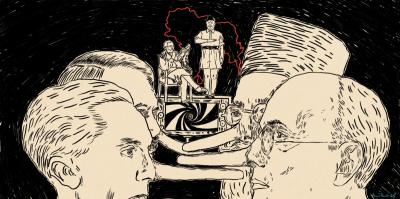

 Himanshu Chakravarty Sharma / मंच